
How to get rid of fungus gnats in houseplants
Fungus gnats live off wet soil. Let it dry out, add a few simple steps, and they'll go away.
You water a plant and a few tiny black flies lift off the soil. A few days later there are dozens of them around the pot, the window and the lamp. These are almost certainly fungus gnats.
The good news is that adult gnats don't harm plants and you can get rid of them without strong chemicals. The less good news is that it takes a few weeks of patience, because you need to break their life cycle.
How to recognise fungus gnats
According to the RHS, adult fungus gnats are dark greyish-brown flies, mostly 3 to 4 mm long. They often run across the soil surface or fly slowly around the plant.
Oregon State University adds that they're attracted to light, which is why you see them at windows and lamps.
The larvae live in the soil. They're slender, whitish maggots with a black head, up to about 6 mm long (RHS). Colorado State University says they stay mostly in the top few centimetres of the potting mix.
Why they showed up
Fungus gnats love wet soil. Colorado State University writes that egg-laying females are strongly drawn to moist potting mix, especially mixes high in peat and old, broken-down mix that holds a lot of water.
A female can lay up to 200 eggs in cracks in the damp soil surface.
At room temperature (about 18 to 24 °C) the whole cycle from egg to adult takes three to four weeks. Generations overlap, so a pot holds eggs, larvae and pupae all at once. That's why a single treatment isn't enough.
They tend to peak in late autumn and winter. Colorado State University explains that plants use less water at that time of year while we keep watering as usual, so the soil stays wet for longer.
Plants that spent the summer outdoors and come back inside in autumn are another common source.
Do they hurt the plant?
Adult gnats don't feed on plants. They're mostly a nuisance. The larvae feed mainly on decaying organic matter and fungi in the soil, but in large numbers they can chew on fine roots.
The RHS says they're really only a concern for seedlings and cuttings, and established plants are usually fine.
Still, gnats are a sign that the soil stays wet for a long time. Iowa State University lists them among the symptoms of overwatering, which can do a plant far more harm than the flies themselves.
How to get rid of them
1. Let the soil dry out
This is the most important step. The University of Wisconsin and Colorado State University both call it the foundation.
Before you water again, let the top layer of soil dry out, at least 2.5 cm and ideally 2.5 to 5 cm. Dry soil cuts down how many eggs and larvae survive.
Empty the saucer and the outer pot. If you like, water from the bottom: stand the pot in water for a while so the roots get a drink and the surface stays drier.
For how to tell when it's time to water, see How to tell when your houseplant needs water.
2. Yellow sticky traps
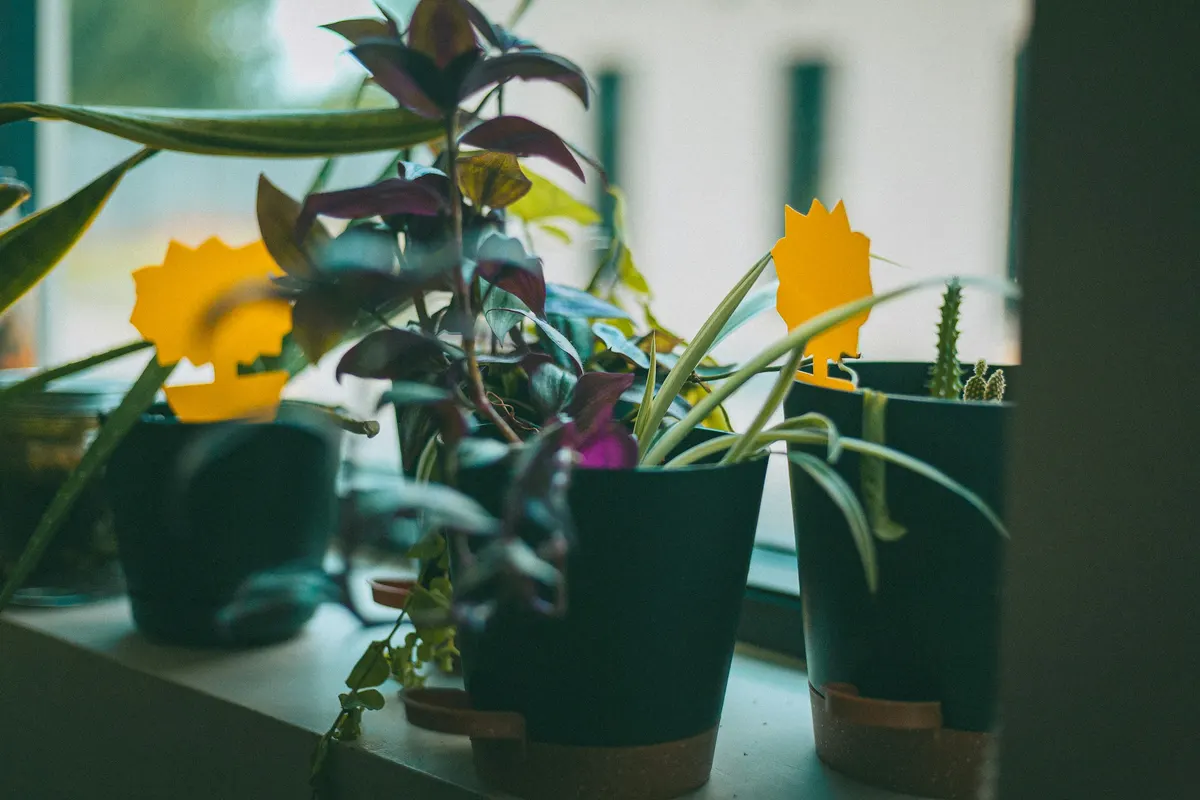
Yellow sticky cards catch adult flies. Colorado State University suggests placing them under the foliage or at the edge of the pot. Oregon State recommends small traps, replaced every few days.
Traps won't touch the larvae in the soil, but they cut down the number of females laying eggs and show you whether things are improving.
3. A layer of sand on top
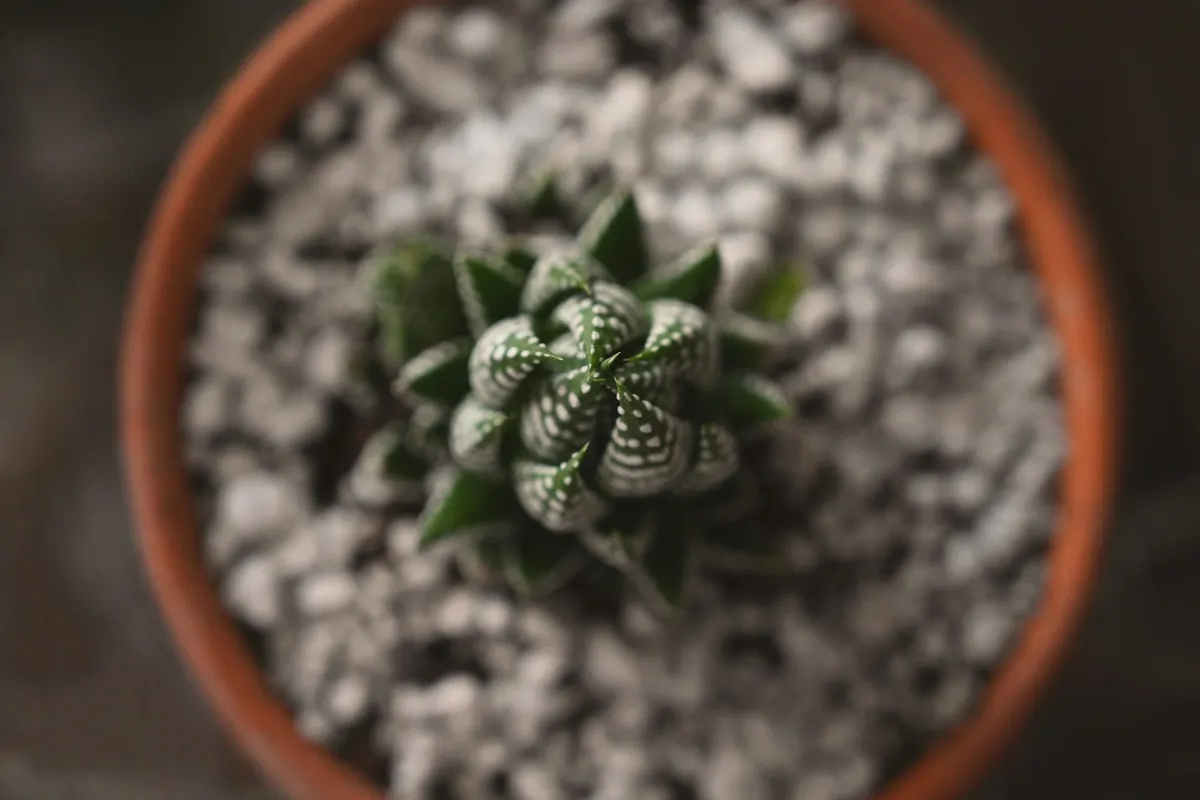
The University of Wisconsin recommends covering the soil with a layer of coarse sand or fine gravel about 1 to 2.5 cm deep. The surface stays drier and females are less likely to lay eggs there.
Combined with changing how you water, Wisconsin says this takes three to four weeks.
4. BTI against the larvae
BTI is the bacterium Bacillus thuringiensis subsp. israelensis, which kills fungus gnat larvae in the soil. It has no effect on adults, eggs or pupae. It's also sold as a mosquito larvae treatment.
Colorado State University notes that products made specifically for fungus gnats are hard to find in ordinary shops.
Oregon State suggests mixing the product into water, letting it soak for about 30 minutes, then pouring the solution onto the soil. The University of Wisconsin recommends repeating the treatment several times, 5 to 7 days apart, to catch newly hatched larvae. Always follow the label.
5. Nematodes
Another biological option is the parasitic nematode Steinernema feltiae. Colorado State calls it especially effective against fungus gnat larvae, and the RHS also lists it as a biological control. You water it into the potting mix.
What about insecticides?
Usually you don't need them. The University of Wisconsin says chemical control is only worth it for a severe infestation, and even then only alongside drier soil and the other steps.
A pyrethrin product labelled for houseplants gives only temporary relief, and it should go on the plant and the soil surface, not into the air.
How to keep them from coming back
- Water by the soil, not by the calendar, and less in winter.
- Use a decent potting mix for houseplants. The RHS calls it the best choice indoors. Oregon State suggests storing it away from infested plants.
- Clear fallen leaves and spent flowers off the soil (Oregon State).
- Replace old, broken-down potting mix, because it holds too much water (Colorado State).
- Keep a new plant away from the others for a few weeks, add a sticky trap and keep an eye on it (Oregon State).
In short
Fungus gnats are a sign that the soil stays wet for too long. Let it dry out, catch the adults on sticky traps and deal with the larvae using BTI, sand or nematodes. Expect it to take three to four weeks to get them under control.
Sources
- University of Wisconsin-Madison, Division of Extension: Fungus Gnats on Houseplants
- Colorado State University Extension: Fungus Gnats as Houseplant and Indoor Pests
- Oregon State University Extension: I have fungus gnats everywhere. Can you help?
- RHS: Fungus gnats (sciarid flies)
- Iowa State University Extension: Diagnosing Houseplant Problems Related to Poor Culture